We are living through a prohibition. Nobody announced it. There was no law, no raid, no padlock on the door. It happened quietly, in the code.
Across 2025 and into 2026, the platforms changed how they treat anything to do with drink. Not an outright ban. Something quieter, and it's written down in black and white. Under Meta's Restricted Goods and Services standards, alcohol is a restricted category: age-gated and fenced off from anyone under the legal drinking age. TikTok's advertising policy on alcohol goes further again. It's governed market by market, your creative can't feature anyone under 25 or anyone pregnant, and you can't so much as hint at a good time had under the influence. And under TikTok's community rules on regulated goods, commercial content that isn't disclosed and compliant becomes ineligible for the For You feed altogether.
Stack the reach collapse that marketers have watched alcohol pages suffer on top of that, and the picture is plain enough. Your followers might still see you. Strangers no longer find you. The algorithms that spent a decade introducing venues to future regulars have closed the door and left no forwarding address.
For a lot of operators, that felt like the floor giving way. For us, it looked like an opening.
The scarce thing has changed
Prohibition never killed demand for a drink. It just made the drink scarce, and made whoever controlled the scarce thing very, very powerful.
The scarce thing today isn't drink. Irish drinking is down roughly a third since its 2001 peak, and the generation coming up now doesn't need us to make alcohol harder to get. They're already ordering the 0.0. The home has quietly replaced the licensed premises as the nation's main venue. 55% of Irish adults who drink now say they're most likely to do it at home. One in three do it at home, alone, at least once a week. That's a lot of empty stools, empty function rooms, and quiet Tuesday covers.
So what's scarce now is two things. The first is reach: a hospitality brand's ability to get in front of new people at all. The second, right behind it, is a reason to walk in the door when getting locked is no longer the point of the evening.
That's the game. Not fighting the prohibition, but owning the thing it made scarce. Al Capone without the armwrestle.
The plot twist nobody clocked
Here's the part that turns a clever observation into a business.
The content that survives the algorithm and the content that pulls a lighter-drinking crowd through the door are the exact same content.
Look at what the platforms still reward, and still allow. They'll strangle a bottle shot with a legible label. But they want people, faces, atmosphere, a room with a story, somewhere you'd want to be on a dark evening in November. Now look at what you're actually selling to someone who isn't coming for the pints, the wine list, or the cocktail menu: the occasion, the company, the ritual, the third place that isn't work and isn't home.
Same footage. One solution to two problems everyone assumed were separate. And the demand is measurable. 39% of Irish adults say more alcohol-free spaces would help them drink less, and that jumps to 64% among 18 to 24 year olds. A quarter of adults now reach for non-alcoholic beer, wine or spirits. Restaurants with a real non-alcoholic menu and late-night cafés top the list of places they actually want to go. When you shoot for the algorithm's blind spot, you accidentally shoot the exact thing that fills seats in a sober-curious country.
Miami Vice, and the Testarossa problem
Great hospitality content has always understood something the algorithm just forced everyone else to learn the hard way.
In Miami Vice, the Ferrari Testarossa is unforgettable. But the camera was never really on the car. It was on Crockett: the man, the mood, the neon. The car signalled. It did its work. It was a prop. Take it away and you still have the show, because the show was never about the car. The car was about the man.
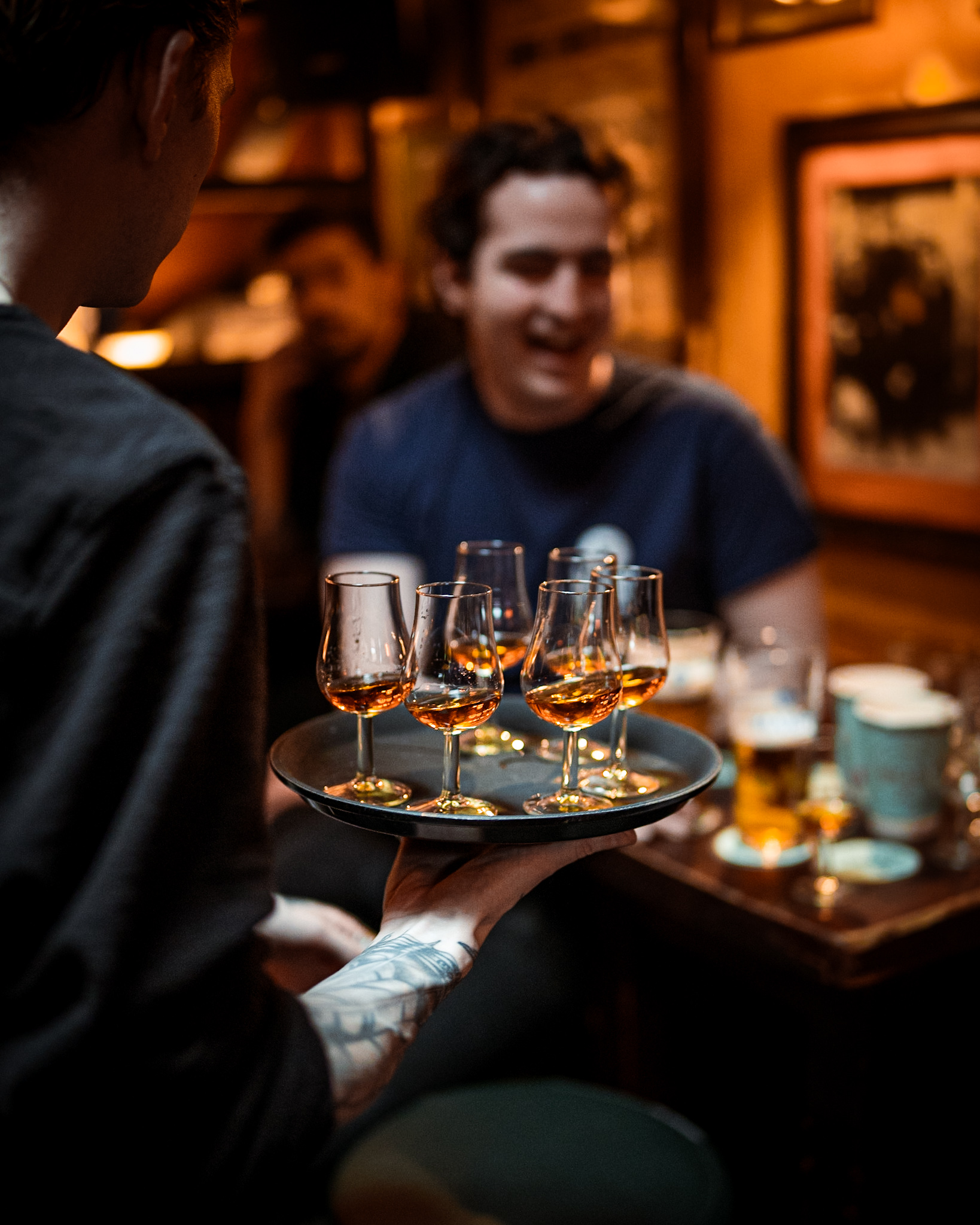
The best rooms shoot drink the same way. The pint, the whiskey, the glass of red, the amber light through it all: a prop that carries mood and status. The mistake, the thing the machines punish, is the moment the human leaves the frame and the bottle becomes the subject. Brand name dead-centre, label legible, no story. To a person, that's craft. To a classifier, it's indistinguishable from an advertisement, so it gets treated like one, and it goes precisely nowhere.
The fix was never to lose the drink. It's to remember whose story it was all along.
Strip out the drink and see what's left
Picture any room in this country worth its salt. The grand hotel bar with a century over the door. The restaurant people book for the room as much as the plate. The corner local that still greets you by name. Strip every last drop of drink out of any of them and what remains? A place full of characters, ritual, warmth and status. An institution, not an off-licence with seating.
The drink is the vocabulary the brand speaks in. It was never the subject. That's the part no algorithm can touch, throttle, or de-recommend, and it's the part that was always worth filming.
What we're actually building
This is the offer HYPE is taking to Ireland's hospitality rooms. Four parts.
The Cast. Every venue already has a Crockett: the barman with the face, the head chef who holds court, the concierge who knows everyone, the room at four o'clock in winter light. We turn each place into its own small cinematic world, with recurring characters, real personalities, and drink kept firmly as the prop. This is the content built to travel, because the platforms still love a human.
The Vault. The beautiful product shots — the single cask, the perfect pour, the flagship cocktail — don't get thrown into a feed engineered to strangle them. They live where the people who already love you actually look: your menu, your gift vouchers, your own list. Stunning work, sent somewhere it can do its job instead of losing a fight with a machine.
The Circuit. A single venue can't out-shout the algorithm alone. Together, they can build something better than reach: a shared audience. HYPE runs the channel that connects the country's best rooms — hotels, restaurants, bars — to the people hunting for a night out, so operators stop scrapping over borrowed attention and start owning the audience outright.
The Usual. The platforms can throttle you, bury you, or switch you off on a whim. An inbox can't. The Usual is the recurring dispatch that turns all of the above into a direct line to the people who already love you: what's on, what's new, the story behind the room, landing with the people most likely to book. It's the one audience you own outright, and the only one no algorithm gets a vote on.
Fame for the room and the people. A customer base no platform can quietly switch off. And a place in the network that owns the night out.
The honest part
This isn't magic and we won't pretend it is. There's no caption clever enough to make a bottle read as "not alcohol" to Meta right now, so we stop measuring beauty shots by reach and start measuring them by what they actually do: build the brand and convert the people already looking.
And it only works if it's the real thing. Real characters, real rooms, real Ireland. A venue that already has a soul? We can make the whole country see it. A place chasing a trend it doesn't believe in? That we can't fake, and wouldn't try.
The prohibition is here. The question isn't whether to fight it. It's who's going to own what it made scarce.
We know a few rooms worth betting on.