Here's a puzzle from this year's industry reports. Ask any CMO what matters in 2026 and you'll hear the same word: authenticity. HubSpot's data says a majority of marketers now believe a distinct point of view matters more than ever, and 53% admit it's harder than ever to make their content stand out.
Now open the feeds those same marketers run. Same hooks. Same formats. Same carousel structure, same talking-head framing, same trending audio, same "we need one of those" briefs. An industry that agrees authenticity is king, producing content you couldn't pick out of a line-up.
The explanation isn't hypocrisy. It's a misunderstanding about what's actually being bought. So let's take it apart properly, because we put a carousel out today saying the quiet part loudly, and this is the long version with the receipts.
Reach and clients are different currencies
Copying a top performer works, in one narrow sense. Ride a proven format and the algorithm often pays out: impressions, maybe a spike, maybe your best week of "performance" this quarter. That's real. It's also the con.
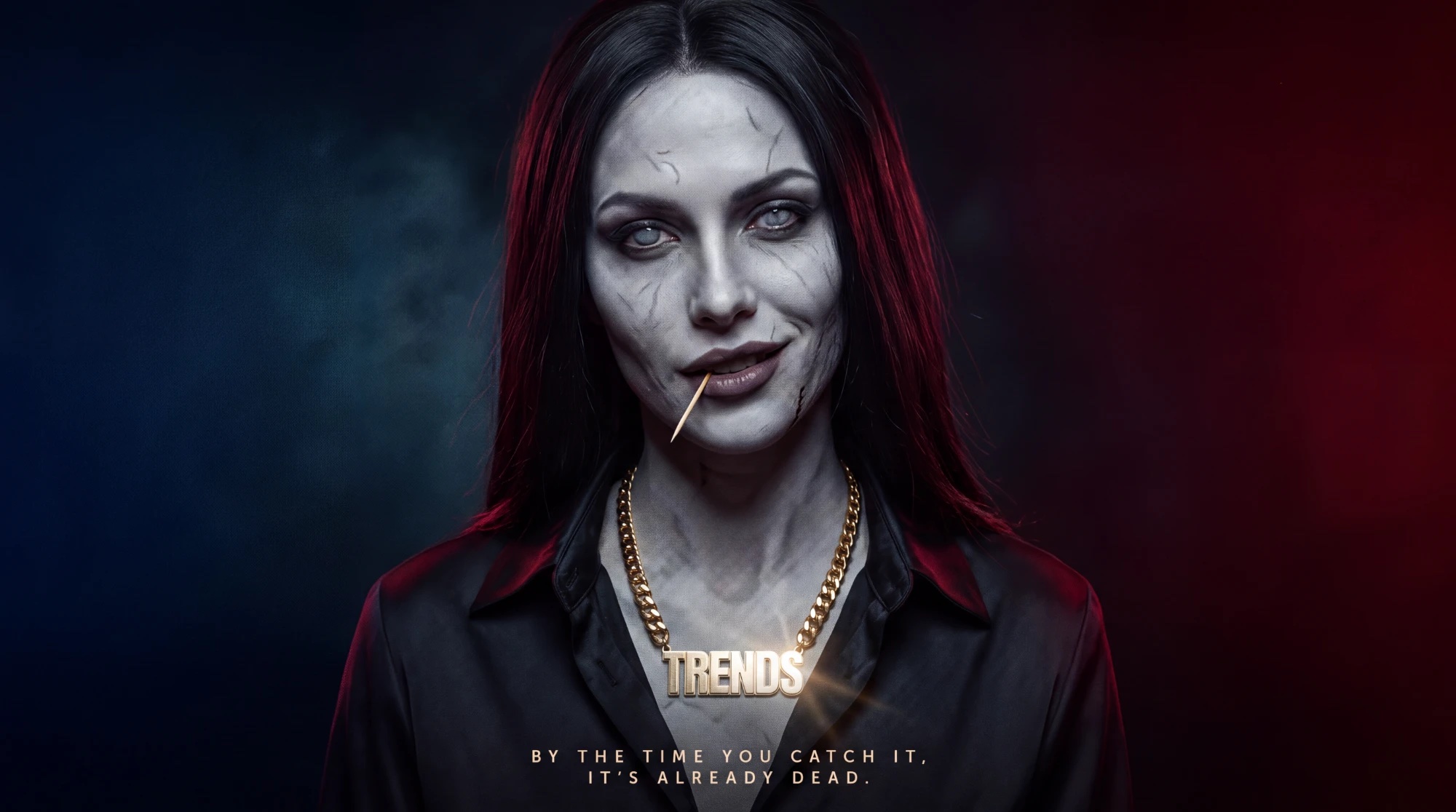
A trend is a queue for something that's running out. By the time a format is visibly winning, you're seeing its peak, not its beginning. You brief it, make it, post it, and arrive precisely as the payout shrinks. The reach was real. It was also rented, at the top of the market, from a machine that's already moved on.
Clients are a different purchase. A client isn't someone who saw you. A client is someone who remembered you at the moment they needed what you sell. Marketing science calls that mental availability, and it's built by linking buying situations to your brand through cues that belong to you. Reach without memory is a crowd walking past your window. And here's the specific problem with borrowed formats: the memory they build files under the format, not under you. Everyone remembers the trend. Nobody remembers whose logo was on version forty-one of it.
The science: your content is building someone's brand. Whose?
This isn't opinion. It's the most replicated finding in modern marketing science. The Ehrenberg-Bass Institute's research on distinctive brand assets shows brands grow by being instantly recognisable: recurring cues, owned codes, a look and sound that couldn't be anyone else. Jenni Romaniuk's data puts distinctive assets at +34% higher advertising recognition, and Ebiquity found campaigns built on recognisable brand ideas deliver +62% stronger short-term profit ROI.
Even the field's two loudest rivals agree here. Mark Ritson and Byron Sharp, who make a sport of disagreeing, shared a Cannes stage this summer and converged on the same instruction: build a brand that looks like itself, then codify everything.
Now run trend-copying through that lens. When your content is indistinguishable from the category's top performer, every recognisable element in it belongs to someone else. The recall you generate leaks to whoever owns the cue, or dissolves into the category. You're paying production costs to build assets you don't hold. There's a word for spending your budget making someone else's brand easier to remember, and the word isn't strategy.
That's the brand confusion cost, and it compounds quietly: each borrowed format teaches your audience one more time that you look like everyone, which is the most expensive thing a small brand can teach the market.
Human-made slop is still slop
We wrote recently about AI saturation and the authenticity backlash, and the standard defence goes: our content is fine, humans made it. But slop was never a production method. Slop is sameness. A human team lovingly recreating this month's winning format is producing artisanal slop, and the audience's scroll-past reflex doesn't check the credits.
The effectiveness research has a blunter word for it: dull. The Cost of Dull project, from Peter Field, Adam Morgan and System1 using IPA data, priced what unremarkable creative actually costs. Dull work needs roughly two to two and a half times the media spend to match the commercial impact of interesting work. Field's estimate of the penalty runs to about €11 million a year in extra media for an average brand, and interesting campaigns can return six or seven times more for every euro behind them. They call it the tedium tax. Blending in isn't the safe option. It's the expensive one. You just pay for it in a different column, where nobody's watching.
The graveyard is full of formats
Every format in the graveyard was guaranteed reach, once. The dance, the sound, the challenge, the template, the hot take, the format of the week. They didn't fail; they expired, because that's what formats you don't own do. Which raises the only question that matters: what doesn't expire?
Consistency does the opposite of expiring. It compounds. System1 and the IPA's Compound Creativity study, built on 4,000+ ads across 44 categories, found that creatively consistent brands produce advertising roughly twice as effective as inconsistent ones, are six times more likely to report very large brand effects, and generate a compounding advantage that would cost the biggest advertisers around €310 million a year in extra media to buy outright. Their conclusion travels well beyond TV: advertising doesn't wear out, it wears in. Every repetition of a format you own makes the next one work harder. Every trend you chase resets the clock to zero.
Taste doesn't expire. Trends do. A format you own outlives every trend you borrow, and the research says it doesn't just outlive it, it out-earns it.
Two CEOs already ran the experiment
You asked for the executive testimony. Here's the cleanest natural experiment the industry has, run by two of the most famous brands alive, in opposite directions.
Airbnb stopped renting attention. Through the pandemic, Brian Chesky cut marketing spend by 58% and kept 95% of the traffic, then made the shift permanent: away from performance spend, into brand, PR and a repeatable creative system. He reframed marketing as education rather than a way to buy customers, and by his own telling the brand became a noun and a verb, with roughly 90% of traffic arriving direct or unpaid. That's the difference between reach and clients, stated as a balance sheet. Rented attention stopped; the clients kept coming, because the memory was already built.
Nike did the reverse, and said so out loud. The most distinctive brand of the last half-century spent years shifting investment away from creating demand for the brand and into capturing demand through performance channels, chasing what the dashboards rewarded. The share price halved from its 2021 peak, and the returning CEO Elliott Hill opened his first earnings call with a diagnosis you should frame above the marketing department door: "We lost our obsession with sport." Not "we lost reach." Nike had reach to burn. It lost the thing the reach was supposed to be building.
One CEO stopped buying attention because the brand made it unnecessary. One admitted the world's greatest brand nearly optimised itself into ordinariness. Same lesson from both directions: the dashboard rewards the chase. The business rewards the build.
The HYPE Method, in long form
So no, the answer isn't reinventing the wheel weekly, and it isn't pretending trends don't exist. It's the three lines from today's carousel, which deserve their footnotes.
Steal the principle, not the format. Every dead format worked for a reason: a curiosity gap, a proof shown not told, a pattern interrupt. Principles are physics; formats are fashion. Take the physics, leave the costume. That's not avoiding inspiration, it's metabolising it, and it's the difference between learning from a top performer and photocopying one.
Build a format you can own. A recurring segment, a signature framing, a voice, a visual code that's unmistakably yours. This is Romaniuk's distinctive-assets playbook applied to content: unique, famous, consistent. It feels slower, because week one of an owned format loses to week one of a borrowed trend. Then the compounding starts, and it's not close. The Clydesdales, the Gecko and Kevin the Carrot are not in the format graveyard, and none of them started as someone else's idea.
Let the trends come to you. When you own a format, trends become raw material instead of orders. The trend passes through your machine and comes out sounding like you; the recognition files to your brand, and the trend does the reaching while the format does the remembering. That's the correct relationship between a brand and the feed: the feed works for you, or it doesn't get the gig.
The CMOs copying each other aren't lazy. They're responding rationally to dashboards that price reach and ignore memory. But reach is rented, clients are earned, and the research on which one compounds isn't ambiguous. Outlive the feed. It's not a slogan. As far as the evidence is concerned, it's the whole job.